


Yoga Nidra Certification Training: What to Look For
Updated: Jun 15
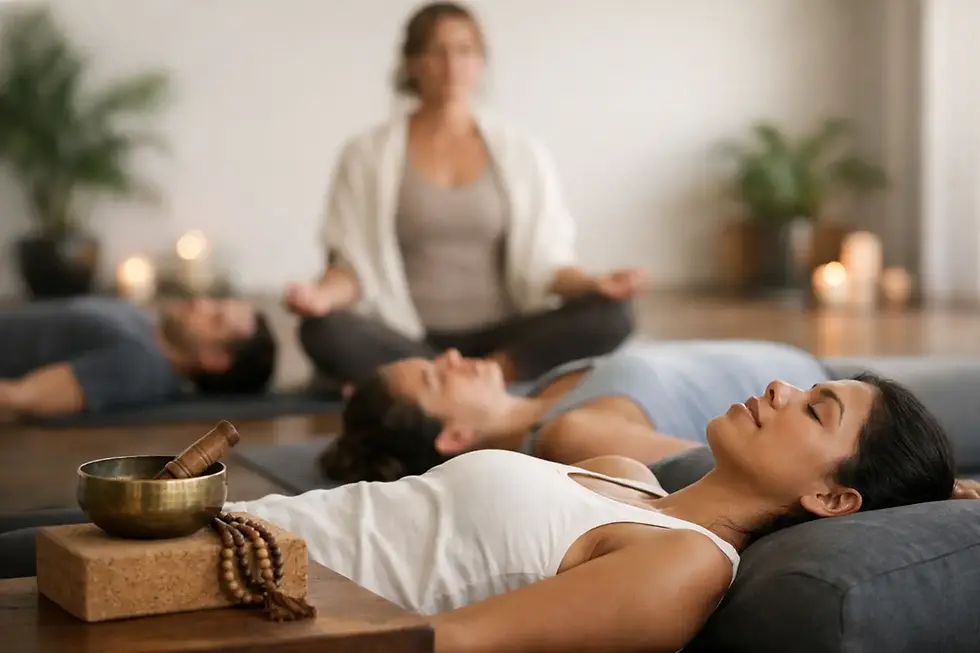
If you are considering yoga nidra certification training, you are probably looking for more than a credential. You may want a method that helps people sleep better, regulate stress, process difficult emotions, and reconnect with a steadier sense of self. You may also want training that feels grounded - not overly mystical, not clinically cold, but intelligent, practical, and deeply healing.
That distinction matters. Yoga Nidra has become more visible in wellness spaces, but not all training programs offer the same depth, safety, or applicability. Some teach a relaxing script. Others teach a transformative process that draws from traditional yogic understanding, modern psychology, and nervous system awareness. If your goal is personal healing, professional competence, or both, it helps to know what separates a meaningful program from a shallow one.
Why yoga nidra certification training deserves careful evaluation
Yoga Nidra is often described as guided yogic sleep, but that phrase only tells part of the story. At its best, it is a systematic method for shifting consciousness, reducing mental and physical tension, and restoring connection between body, mind, and deeper awareness. For many people, that leads to better sleep, lower anxiety, improved focus, and greater emotional resilience.
For practitioners and professionals, the implications are even broader. Yoga Nidra can support clients dealing with burnout, trauma patterns, chronic stress, grief, insomnia, and psychosomatic symptoms. But this is also where training quality becomes essential. A facilitator who understands states of consciousness, trauma sensitivity, and the relationship between practice structure and nervous system response will guide very differently than someone who has simply memorized a script.
Strong certification training teaches you how and why the practice works. It helps you recognize when to pace slowly, when to simplify language, and when a participant may need more grounding rather than more inner exploration. That level of discernment is what builds trust and creates real outcomes.
What a high-quality yoga nidra certification training should include
A credible program should offer more than a sequence of steps. It should give you a framework.
First, look for a training that honors the roots of Yoga Nidra while making it relevant for modern life. Ancient yogic wisdom provides the philosophical map, but students also need language and tools that speak to stress physiology, emotional regulation, sleep health, and behavior patterns. When a program can bridge those worlds well, the learning becomes more than conceptual. It becomes usable.
Second, the curriculum should address the architecture of the practice. That includes intention, body sensing, breath awareness, emotional and cognitive integration, imagery, and the movement between different states of consciousness. These elements are not random. Each one has a role, and the way they are taught affects both safety and effectiveness.
Third, pay attention to whether the training develops your own inner experience. This is often overlooked. You cannot guide others into deep rest and self-inquiry if your relationship to the practice remains purely intellectual. The best programs ask you to experience Yoga Nidra as a path of self-study and self-mastery, not just as a skill set.
Finally, teaching methodology matters. You should learn how to adapt Yoga Nidra for different audiences, including private clients, groups, wellness settings, and therapeutic contexts. A class for exhausted professionals may need a different tone and pacing than a practice designed for yoga teachers, trauma survivors, or people navigating depression.
The role of psychology, science, and therapeutic understanding
Many people seeking certification are drawn to Yoga Nidra because it feels gentler than effort-based self-improvement. That is part of its power. Yet gentleness is not the same as simplicity.
Effective training should help you understand how Yoga Nidra influences the autonomic nervous system, attention, habit patterns, and the body-mind connection. You do not need a clinical degree to benefit from this material, but you do need enough understanding to guide responsibly. If a participant becomes emotionally activated, dissociated, restless, or unusually fatigued, you should have some framework for what may be happening.
This is where a research-informed approach becomes valuable. Science can help explain why guided rest changes sleep patterns, why interoceptive awareness supports regulation, and why certain forms of language affect the brain differently than performance-oriented instruction. It also helps professionals communicate the value of Yoga Nidra to clients who want evidence, not vague promises.
At the same time, science should not flatten the practice into mere stress reduction. The deeper tradition of Yoga Nidra points toward wholeness, insight, and freedom from conditioned patterns. Strong training respects both dimensions - therapeutic benefit and spiritual depth - without forcing students into language that does not fit their background.
How to know if a program matches your goals
Not everyone enters yoga nidra certification training for the same reason. Some want to teach. Some want a structured path for personal healing. Some are therapists, coaches, or yoga teachers who want to expand their work with a body-based, consciousness-based practice.
If your primary goal is personal transformation, choose a program that prioritizes direct practice, mentorship, and integration. You want enough space to notice your own patterns around striving, fatigue, anxiety, identity, and rest. Certification can be meaningful, but your inner shift is what will make the training life-changing.
If your goal is professional application, make sure the training addresses scope, adaptation, and communication. You should leave knowing how to introduce the practice clearly, when to use shorter or longer formats, and how to support a range of student needs without overstepping your role.
If you want both personal and professional growth, you need a program that does not treat those aims as separate. The most effective facilitators are often the ones who have experienced the practice not only as a method, but as a relationship with themselves.
Questions worth asking before you enroll
A program may look impressive on paper and still not be the right fit. Before enrolling, ask how the training defines Yoga Nidra. Ask whether the curriculum is script-based or principle-based. Ask how much supervised practice, feedback, and experiential learning is included.
It is also wise to ask about the teacher's lineage, clinical awareness, and practical teaching experience. Founder-led programs often carry a clearer methodology because the approach has been developed, taught, and refined over time rather than assembled from trends. That depth can make a significant difference, especially if you plan to teach others.
You may also want to understand the training format. Self-paced learning offers flexibility, which is valuable for busy professionals and caregivers. Live training offers direct mentorship and the chance to ask nuanced questions in real time. Neither is automatically better. It depends on how you learn, how much support you need, and whether accountability helps you stay engaged.
Programs such as those taught by Kamini Desai are often appealing because they speak to both the inner and professional dimensions of Yoga Nidra, while integrating yogic wisdom with modern psychology in a clear and teachable way.
Red flags in yoga nidra certification training
Be cautious of any training that promises instant mastery. Yoga Nidra is subtle work. It asks for presence, listening, and discernment. A weekend of content may inspire you, but real competency usually requires ongoing practice and integration.
Another red flag is language that treats Yoga Nidra as universally soothing for everyone in every situation. While many people find it profoundly regulating, some participants need titration, modified guidance, or shorter experiences. A responsible training acknowledges this complexity.
It is also worth questioning programs that rely heavily on vague spiritual claims while offering little structure. Depth and rigor can coexist. In fact, they should. A sound training does not need to dilute the tradition, but it should be able to explain its process clearly and teach it with integrity.
What the right training can change
When yoga nidra certification training is well designed, its value extends far beyond a certificate. It can reshape the way you understand rest, healing, and transformation. It can help you move from managing symptoms to addressing underlying patterns. It can also give you a method for supporting others without relying on pressure, performance, or constant cognitive effort.
For some students, the greatest change is personal. They sleep through the night for the first time in years. They feel less hijacked by anxiety. They discover that deep rest is not laziness but medicine. For others, the shift is professional. They gain a modality that fits naturally into yoga teaching, therapy-informed wellness work, coaching, or integrative health practice.
The right training does not simply teach you what to say during a session. It teaches you how to relate to consciousness, healing, and human complexity with more skill and compassion.
If you are choosing this path, let your standard be depth, not hype. The best yoga nidra certification training will help you become steadier in yourself first. From that place, whatever you offer others will carry far more clarity, safety, and power.
Comments