


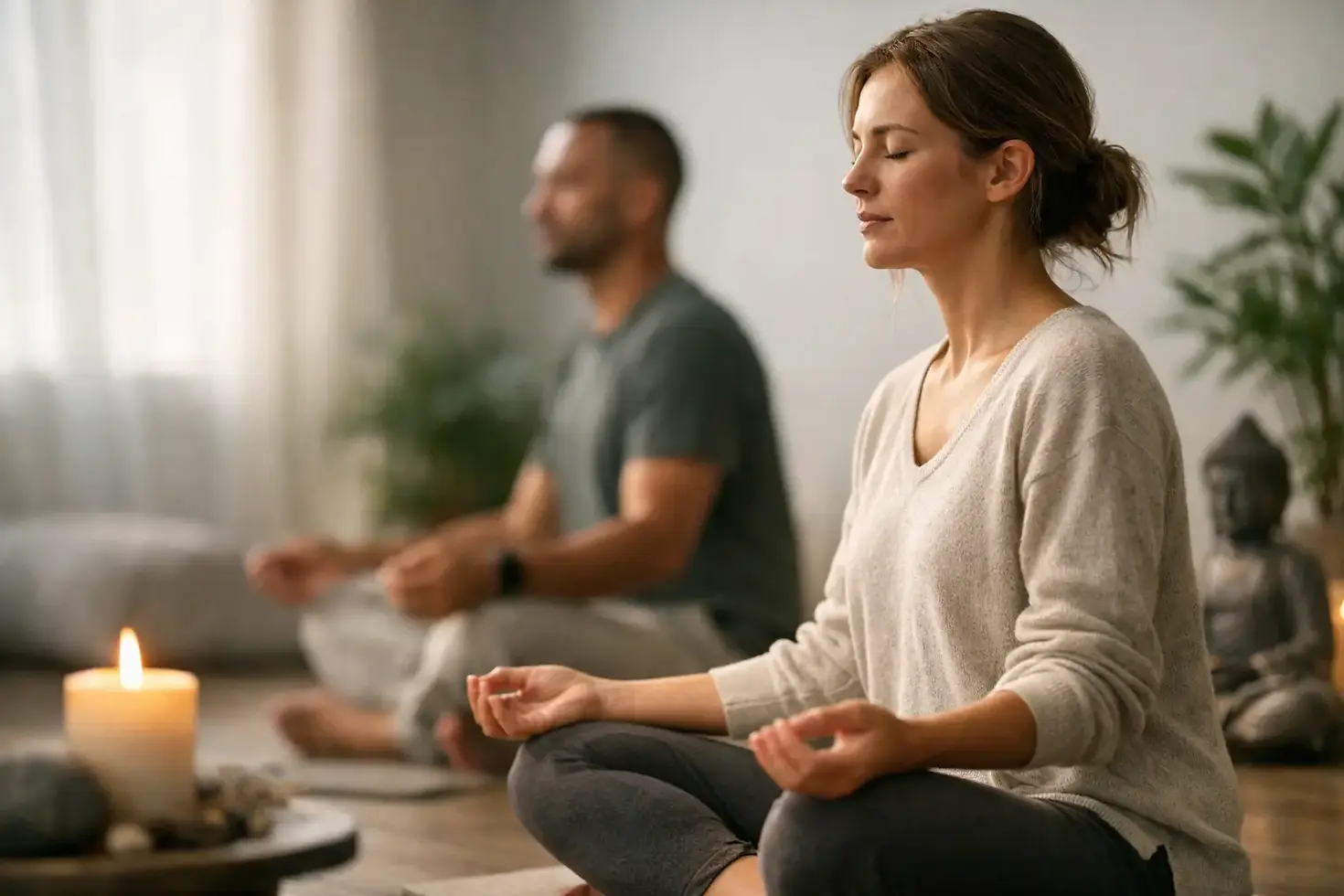
Your Guide to Trauma Sensitive Meditation
- 6 days ago
- 5 min read
A meditation instruction to “close your eyes, be still, and go within” can feel restorative for one person and intensely activating for another. A guide to trauma sensitive meditation begins by honoring that difference. The goal is not to push past discomfort or force a calm state. It is to create conditions in which your body and mind have more choice, more orientation, and more room to settle at their own pace.
Trauma-sensitive meditation is especially valuable for people living with anxiety, insomnia, burnout, chronic tension, or the lingering effects of overwhelming experiences. It adapts contemplative practice to support nervous system regulation rather than asking the nervous system to override its own protective responses.
What Makes Meditation Trauma Sensitive?
Trauma-sensitive meditation recognizes that attention is powerful. Directing attention inward can bring relief, but it can also bring up sensations, memories, emotions, numbness, agitation, or a sense of disconnection. None of these responses means you are doing meditation incorrectly. They may be signs that the body is trying to protect you.
A trauma-sensitive approach is built around three principles: choice, pacing, and present-moment orientation. You are invited rather than commanded. You can shift your posture, open your eyes, stop a practice, or focus on something outside yourself at any time. This restores a sense of agency, which is often central to healing.
The practice also respects pacing. A longer meditation is not necessarily a better meditation. Two minutes of feeling safely connected to your breath, your feet, or the room around you can be more regulating than 30 minutes spent trying to endure activation.
Start With Safety, Not Stillness
Many people assume meditation requires lying down, sitting motionless, and closing the eyes. These are options, not requirements. For a trauma-sensitive practice, begin by choosing the conditions that help you feel most supported.
You may prefer to sit in a chair with both feet on the floor, lean against a wall, or practice while standing. Keep your eyes open or softly lowered if that feels more settling. Notice the door, the windows, the light in the room, and a few neutral or pleasant objects. This simple orientation reminds the nervous system: I am here, and this moment is different from the past.
Before beginning, ask yourself, “What would help me feel 5 percent more comfortable right now?” The answer may be a blanket, a glass of water, a different room, or permission to practice for only three minutes. Small adjustments can change the entire experience.
A Gentle Practice for Returning to the Present
This short practice is designed to build steadiness without demanding deep internal focus. Move through it slowly, and skip any step that does not feel supportive.
Orient to Your Surroundings
Keep your eyes open if you wish. Let your gaze move naturally around the room. Name three things you can see, either silently or aloud. Notice colors, shapes, and distances. Then identify two sounds you can hear, including sounds that may be far away.
There is no need to search for perfect quiet. The purpose is to help your attention recognize the safety cues available in your current environment.
Find Contact and Support
Bring attention to one place where your body meets support: your feet on the floor, your back against a chair, or your hands resting in your lap. You do not need to feel your entire body. One clear point of contact is enough.
Notice the pressure, warmth, texture, or steadiness there. If body sensation feels too intense, return your attention to an object in the room. Moving between inner and outer awareness is a skill, not a distraction.
Let the Breath Be Natural
Rather than taking a deep breath, simply notice that breathing is already happening. You might sense the movement of air at the nostrils, the rise and fall of the chest, or no distinct sensation at all. All are acceptable.
For some people, breath awareness can create anxiety or a feeling of constriction. If that happens, shift to feeling your feet, listening to ambient sound, or gently tracing the outline of a familiar object with your eyes. Meditation does not require breath focus to be effective.
End Before You Need To
Choose a clear ending point. Look around the room again, move your fingers and toes, and notice one thing you would like to do next. Ending while you still feel resourced teaches the nervous system that inner attention can be approached and released safely.
How to Work With Activation, Numbness, or Restlessness
Meditation is not meant to make you tolerate distress alone. If you notice panic, dizziness, flooding emotions, vivid images, dissociation, or a strong urge to escape, pause the practice. Open your eyes, change position, and orient to the room. Press your feet into the ground or hold something cool or textured.
It can help to use a simple scale from zero to 10. If your distress is moving above a manageable level, often around a five or six, widen your attention outward rather than continuing to focus inward. You might stand up, walk slowly, call a trusted person, or engage in another grounding activity.
Numbness deserves the same compassion. A blank or disconnected feeling may be a protective response, not a lack of progress. Instead of trying to feel more, notice one neutral fact: the temperature of the room, the sound of a fan, or the sensation of fabric against your hand. Healing often begins with small, tolerable moments of contact.
Why Choice Matters in Trauma-Sensitive Meditation
Traditional meditation language can sometimes sound absolute: remain still, observe without reacting, stay with the sensation. While these instructions may be useful in certain settings, they are not universally appropriate. For someone with a trauma history, being told to remain with overwhelming sensations can echo experiences of powerlessness.
Choice-based language changes the relationship to practice. Try phrases such as “if it feels comfortable,” “you may notice,” and “you can return to the room whenever you choose.” This is not avoiding growth. It is creating the internal trust that makes meaningful growth possible.
In Yoga Nidra, this principle can be especially supportive. A well-guided practice offers anchors such as sound, breath, body contact, imagery, and intention, while allowing the practitioner to choose what feels accessible. In I AM Yoga Nidra™, the invitation is not to force relaxation, but to rest in an awareness that can include the changing experiences of body and mind.
Build a Practice That Fits Your Nervous System
Consistency helps, but consistency does not have to mean practicing the same way every day. On a settled day, you may enjoy a 15-minute guided practice. On a depleted day, one minute of orienting to the room may be the wiser choice.
Consider creating a personal menu of regulating options: sitting with eyes open, walking slowly, listening to a guided Yoga Nidra practice, placing a hand on a neutral area of the body, or noticing the support beneath you. Having options available reduces the pressure to make one method work in every state.
Timing also matters. If you are working with insomnia, a gentle practice before bed may help signal rest. Yet if lying down increases vigilance or brings up difficult material, use a seated practice earlier in the evening instead. The most effective practice is the one that leaves you feeling more connected, capable, and present afterward.
When Additional Support Is Needed
Meditation can be a meaningful part of healing, but it is not a replacement for trauma-informed mental health care. If practice regularly brings intense flashbacks, self-harm urges, prolonged dissociation, or feelings that are difficult to manage alone, seek support from a licensed therapist or qualified trauma-informed provider.
For yoga teachers, coaches, and helping professionals, trauma sensitivity also means staying within your scope of practice. You can offer choice, clear permission, and grounding practices without interpreting someone’s trauma or trying to process it for them. A calm, responsive referral can be one of the most caring interventions.
Your practice does not need to be dramatic to be transformative. Each time you recognize a limit, choose an adjustment, and return to one small source of support, you are practicing a deeper form of meditation: the capacity to meet yourself with awareness, dignity, and care.
Comments