


Is Yoga Nidra Scientifically Proven?
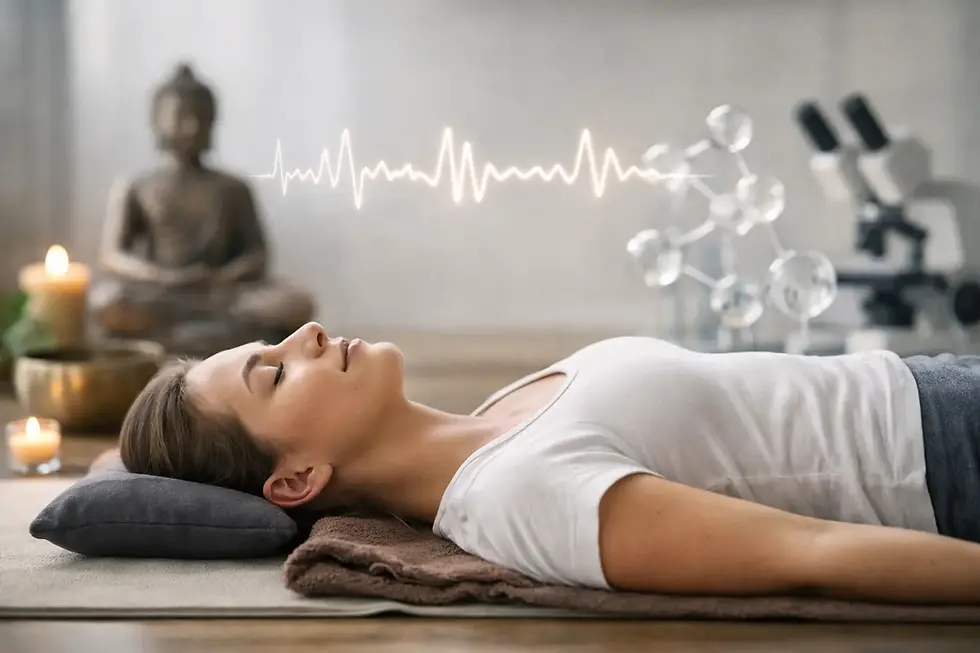
If you are asking, is yoga nidra scientifically proven, you are likely looking for more than a pleasant relaxation technique. You want to know whether this practice can genuinely help with sleep, stress, anxiety, burnout, and emotional overload - and whether the claims around it hold up under serious examination.
The honest answer is yes, to a degree. Yoga Nidra is supported by a growing body of research that suggests meaningful benefits for stress reduction, sleep quality, nervous system regulation, mood, brain health and overall well-being. At the same time, science has not proven every claim made about Yoga Nidra, and not every study is equally strong. The evidence is promising, but it needs to be understood with nuance.
That nuance matters, especially if you are trying to heal from chronic stress, trauma patterns, insomnia, or persistent inner agitation. When a practice affects the body, mind, and emotions so directly, the real question is often not simply whether it is proven, but what has been studied, for whom, and under what conditions.
Is yoga nidra scientifically proven for stress and sleep?
This is where the evidence is most compelling. Yoga Nidra has been studied in relation to perceived stress, sleep disturbance, anxiety, and physiological markers of relaxation. Across multiple studies, participants often report reduced stress, improved sleep, better emotional balance, increased sense of calm after regular practice and greater focus.
That makes sense from both a yogic and scientific perspective. Yoga Nidra systematically guides attention inward while inviting deep physical relaxation and receptive awareness. In practical terms, this can reduce hyperarousal - the state in which the nervous system remains vigilant, reactive, and unable to fully settle. For people who feel tired but wired, this shift is often the beginning of healing.
Research has also explored how Yoga Nidra may influence autonomic nervous system function. Some studies suggest movement toward parasympathetic dominance, which is associated with rest, digestion, recovery, and repair. Others have noted improvements in heart rate variability, stress perception, and sleep-related outcomes. While others still have established that Yoga Nidra increases your own body's release of dopamine creating feelings of focus, energy, motivation and positive outlook. These findings do not mean Yoga Nidra is a cure-all, but they do support its role as a legitimate regulatory practice.
For sleep, the results are especially relevant. People with insomnia or poor-quality sleep often struggle not just with fatigue, but with an overactive mind and body. Yoga Nidra may help interrupt this cycle by training the system to enter the states of ease and non-mind required to fall asleep. The practice does not force sleep. Instead, it creates conditions in which sleep becomes more possible.
What the science actually shows
One reason the question is yoga nidra scientifically proven can be difficult to answer cleanly is that Yoga Nidra studies vary in quality. Some are small. Some use different protocols. Some combine Yoga Nidra with other interventions, making it harder to isolate results. That is common in mind-body research, but it does mean we should avoid overstating certainty.
Even so, several patterns appear consistently. First, regular practice tends to produce better outcomes than occasional use. Second, people dealing with stress-related symptoms often experience the clearest benefits. Third, subjective improvements matter. Better sleep, less tension, lower anxiety, and improved emotional regulation are not trivial outcomes simply because they are self-reported. They are central to quality of life.
Brain-based research adds another layer of interest. Studies using EEG and other measures suggest Yoga Nidra may be associated with changes in brain wave activity linked to deep relaxation and altered states of awareness. This does not mean the practice is magical or beyond explanation. It means the brain appears to respond in measurable ways when attention is guided skillfully into non-ordinary states of rest and awareness.
Science also supports a broader principle that strengthens the case for Yoga Nidra: practices that combine body stillness, breath awareness, interoception, and guided attention can reduce stress reactivity and improve self-regulation. Yoga Nidra sits squarely within that category, while also offering a uniquely structured method drawn from a rich contemplative tradition.
Where the evidence is strong and where it is still emerging
The strongest support is around stress reduction, relaxation, sleep improvement, and general psychological well-being. There is also emerging research on Yoga Nidra for anxiety, depression, PTSD symptoms, chronic pain, menstrual health, and burnout. Some studies suggest meaningful benefit, but these areas still need larger and more rigorous trials.
This distinction is important. It is reasonable to say Yoga Nidra is evidence-informed and increasingly supported by science. It is less accurate to say science has definitively proven every therapeutic claim associated with it.
For example, Yoga Nidra has been shown to help people with trauma histories. In fact, it has been approved by the Department of Defence as a complementary treatment for PTSD. That said, trauma-sensitive application matters enormously. A generic script is not always enough. For some individuals, lying still with eyes closed can initially increase distress rather than reduce it. In those cases, the practice may need adaptation, pacing, choice, and skilled guidance. Science supports nervous system regulation, but healing is rarely one-size-fits-all.
The same is true for depression. Some people feel brighter, more resourced, and more connected after practice. Others may find that they need additional support through therapy, medical care, community, or other integrative approaches to support the clearing effects of Yoga Nidra. This powerful and positive spontaneous clearing of what has been suppressed and may be causing depression/anxiety or other symptoms is important. For some, this effect goes unnoticed and happens organically and naturally. For others support is needed. Yoga Nidra can be a powerful part of a healing plan, but it should not be positioned as the only answer when symptoms are severe.
Why Yoga Nidra can feel effective so quickly
One reason people often trust Yoga Nidra before they ever read a research paper is simple: they feel a change. The jaw softens. The breath deepens. Mental noise quiets. Sleep comes more easily. Emotional reactions lose some of their grip.
These shifts are not imaginary. When the nervous system moves out of persistent activation, the body reallocates energy. Muscles release unnecessary holding. Stress chemistry may begin to settle. Attention becomes less fragmented. From a therapeutic standpoint, this creates internal conditions that support healing, insight, and resilience.
Yoga Nidra also helps many people develop interoceptive awareness - the capacity to notice internal sensations without immediately reacting to them. That skill can improve emotional regulation over time. Rather than being swept away by stress, you begin to recognize it earlier and respond with more choice.
This is one reason the practice has value beyond relaxation. Relaxation is helpful, but regulation is deeper. A person who learns to access steadiness in the face of stress is building a new relationship with the body and mind.
Is yoga nidra scientifically proven enough to be worth practicing?
For most people, yes. If your standard is that every aspect must be established by large-scale, definitive research, then no contemplative practice will satisfy you completely. But if your standard is whether there is credible, growing evidence combined with low risk and meaningful real-world benefit, Yoga Nidra deserves serious attention.
It is especially worth exploring if you struggle with sleep disruption, chronic stress, anxious rumination, overwhelm, or exhaustion that does not improve through effort alone. It can also be valuable for therapists, coaches, yoga teachers, and healing professionals who want a practice that supports both personal regulation and professional presence.
What matters is how you practice. A rushed recording used once during a stressful week is different from a consistent, skillfully guided method. Duration matters less than regularity. Twenty to thirty minutes practiced consistently can be more transformative than an occasional longer session.
It also helps to choose an approach that respects both the roots of Yoga Nidra and the realities of modern nervous system health. The most effective teaching does not force spirituality, nor does it strip the practice of depth. It integrates contemplative wisdom with practical understanding of sleep, stress, trauma, and behavior change.
This is where a research-informed method can make a real difference. Kamini Desai's work, for example, has helped many students and professionals understand Yoga Nidra not just as relaxation, but as a structured path of self-regulation, self-inquiry, and lasting inner transformation.
A grounded answer to a common question
So, is yoga nidra scientifically proven? It is scientifically supported, increasingly studied, and clinically relevant for many of the issues people care about most - especially stress, sleep, and emotional regulation. It is not beyond question, and it should not be oversold. But it is far more than a wellness trend.
When practiced consistently and taught skillfully, Yoga Nidra offers something many people are missing: a repeatable way to rest deeply, reorganize the nervous system, and reconnect with an inner steadiness that modern life easily disrupts. Sometimes the most convincing proof begins there - in the body becoming quiet enough to heal.
Comments